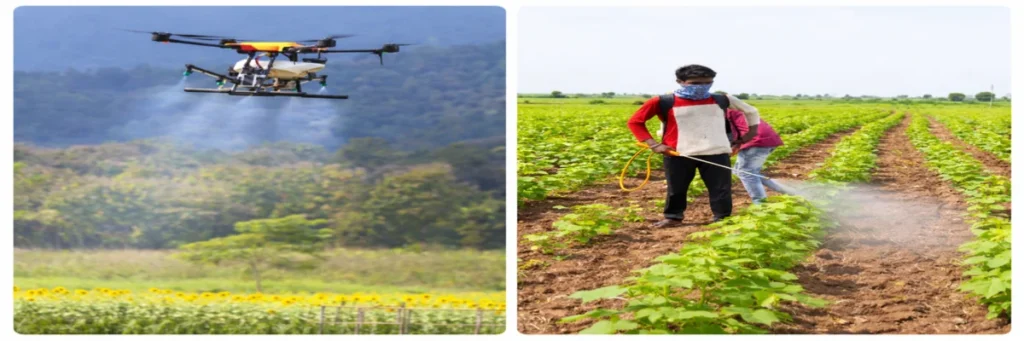
Spraying is an important part of farming. Farmers spray pesticides, fertilizers, and nutrients to protect crops and improve yield. For many years, manual spraying was the common method used in agriculture. Today, drone spraying is becoming popular because it is faster and more advanced.
Many farmers now ask one common question: Drone spraying vs manual spraying, which is better?
The answer depends on farm size, budget, labor availability, and spraying needs.
In this blog, we will compare both methods in a simple way.
What is Drone Spraying?
Drone spraying uses agricultural drones fitted with spray tanks, nozzles, and GPS systems to spray crops from above.
These drones can follow a planned route and spray the field evenly. They are mostly used in modern farming for faster and safer spraying.
Main features of drone spraying:
- Automated flight path
- Quick coverage of large areas
- Reduced labor requirement
- Less contact with chemicals
- Useful for tall and dense crops
Drone spraying is commonly used in crops like paddy, cotton, maize, sugarcane, and vegetables.
What is Manual Spraying?
Manual spraying is the traditional method where farmers use hand-operated, knapsack, motorized, or tractor-mounted sprayers to apply chemicals directly to crops.
This method is still widely used, especially on small farms and in areas where advanced spraying technology is not yet common.
Common types of manual spraying:
- Knapsack sprayer
- Hand pump sprayer
- Motorized backpack sprayer
- Tractor-mounted sprayer
Drone Spraying vs Manual Spraying
| Factor | Drone Spraying | Manual Spraying |
|---|---|---|
| Method | Uses agricultural drones to spray from above | Uses hand-held, knapsack, motorized, or tractor-mounted sprayers |
| Speed | Fast and covers large areas quickly | Slow and takes more time |
| Labor Requirement | Usually needs one trained operator | Requires more workers |
| Safety | Less direct contact with chemicals | Higher exposure to chemicals |
| Spray Coverage | More uniform when operated properly | Coverage may be uneven |
| Water Usage | Uses less water in many cases | Uses more water |
| Field Accessibility | Good for tall crops, muddy fields, and difficult areas | Hard to use in dense crops or rough land |
| Crop Damage | Less crop disturbance | Possible crop damage while walking through the field |
| Cost | Higher initial or service cost | Lower initial cost |
| Training | Requires technical training | Easy to use with basic knowledge |
| Best For | Medium and large farms | Small farms |
| Main Advantage | Faster, safer, and efficient | Affordable and simple |
| Main Limitation | Higher cost and battery dependence | Slow and labor-intensive |
Advantages of Drone Spraying
Drone spraying offers many benefits for modern farming.
1. Saves Time
Drones can spray large areas much faster than manual spraying. This is very useful when farmers need quick action against pests or diseases.
2. Reduces Labor Need
Only one trained operator is usually needed for drone spraying. This helps farmers who face labor shortages.
3. Improves Safety
Drone spraying reduces direct contact with harmful chemicals. Farmers do not need to walk inside the field while spraying.
4. Better for Large Farms
Drone spraying is more suitable for medium and large farms because it can cover more area in less time.
5. Useful in Difficult Fields
Drones can spray easily in tall crops, muddy fields, waterlogged land, and difficult terrain where manual spraying is hard.
Advantages of Manual Spraying
Manual spraying is still useful in many farming situations.
1. Low Initial Cost
Manual sprayers are cheaper to buy compared to spray drones.
2. Easy to Use
Farmers are already familiar with manual spraying methods, and no advanced technical knowledge is needed.
3. Suitable for Small Farms
For small land holdings, manual spraying may be enough and more economical.
4. Easy Availability
Manual spraying equipment is commonly available in local markets and rural areas.
Limitations of Drone Spraying
Although drone spraying has many benefits, it also has some limitations.
- Higher initial cost
- Requires trained operator
- Battery charging is needed
- Service availability may be limited in some areas
- May not be economical for very small farms
Limitations of Manual Spraying
Manual spraying also has several drawbacks.
- Slow process
- More labor required
- Direct exposure to chemicals
- Uneven spraying can happen
- Hard work in large fields
- Difficult in dense or tall crops
Which Method Is Better?
Both methods have their own importance, but the better choice depends on the farm’s needs.
Manual spraying may be better when:
- The farm is small
- The budget is low
- Labor is available
- Spraying work is limited
Drone spraying may be better when:
- The farm is medium or large
- Fast spraying is needed
- Labor shortage is a problem
- Farmer wants safer spraying
- Field conditions are difficult