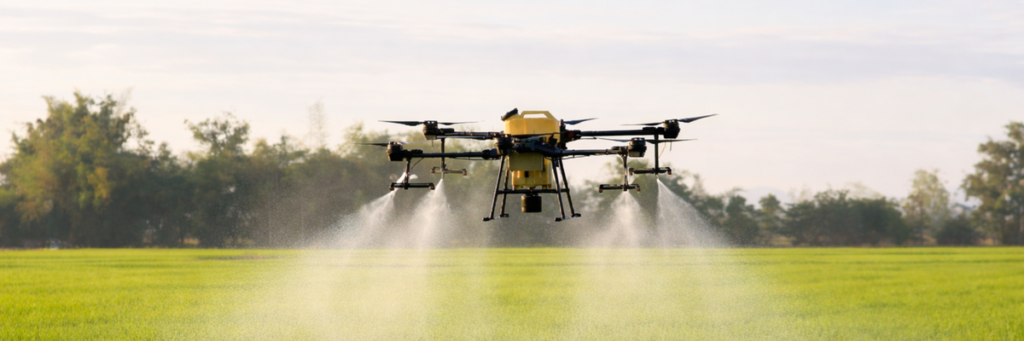
Agricultural drone services are transforming farming in India by helping farmers act earlier, cover more ground in less time, and manage crop operations with better visibility. In farming, delays can be costly. A pest issue that goes unnoticed for a few days, an irrigation problem in one section of a field, or uneven spraying during a critical crop stage can affect overall output. Drone services help reduce that delay by giving farmers and agri-businesses a faster way to see what is happening across the field.
This is why drone services are becoming more important in Indian agriculture. They are not being adopted simply because they are modern. They are being used because they solve practical farm problems.
Why Traditional Field Monitoring Is Often Not Enough
Many farmers still depend on manual observation to understand field conditions. That method remains important, but it has limits. Walking through a field takes time, especially when the land area is large or spread across multiple plots. It also gives only a partial view. A farmer may notice visible issues in one section, but other parts of the field may not get the same level of attention at the same time.
This becomes more difficult during critical periods such as early crop stress, pest activity, irrigation imbalance, or pre-harvest monitoring. By the time the issue is clearly visible across the field, the impact may already be larger than expected.
Agricultural drone services help close that gap. Instead of checking the field section by section, drones provide a wider view in less time. That makes it easier to identify uneven growth, damaged patches, water-related problems, or areas that need closer inspection.
What Agricultural Drone Services Actually Do
Agricultural drone services support farming operations through aerial field monitoring, crop observation, spraying support, and field analysis. These services are usually provided by trained professionals who operate the drone, capture the required visuals or data, and help the farmer or agri-business understand the field condition more clearly.
This service model is important in India because many farmers do not want to buy equipment, learn technical workflows, and manage drone operations on their own. What they need is the outcome: faster visibility, more efficient spraying, and better awareness of field conditions. A service provider makes that possible without pushing the full technical burden onto the farmer.
That is one of the main reasons agricultural drone services are growing. They make the benefits of drone technology more practical to access.
Faster Crop Monitoring Across Large Areas
One of the biggest ways drone services are changing farming in India is through faster crop monitoring. In many farming operations, reviewing field condition manually can take hours or even longer, depending on the size of the land and how accessible it is. A drone can cover the same area much more quickly and provide a broader view of the crop.
This matters because crop issues are not always uniform. One section of a field may show strong growth while another may have weak development, water stress, or visible damage. From the ground, it is harder to understand these patterns across the full farm. From the air, they become easier to notice.
For farmers, this means field review becomes less about guesswork and more about observation. Instead of assuming all sections are performing the same way, they can identify where attention is needed first.
Better Field Analysis Supports Better Decisions
Agricultural drone services are not only about saving time. They also improve the quality of field assessment. Aerial visibility helps reveal patterns that are easy to miss from ground level. This can include uneven crop growth, poor drainage, waterlogging, bare patches, weak zones, or changes in crop condition over time.
This is useful because farming decisions often depend on knowing where the real problem is. When a field is treated as if every area has the same condition, inputs may be used inefficiently and time may be lost. Drone-based field analysis helps farmers focus attention where it is actually needed.
In practical terms, this means better follow-up. A farmer can inspect the exact section that looks affected, review irrigation in that zone, check for pest pressure, or decide whether action is required immediately. The drone does not replace farming knowledge. It strengthens it by improving visibility.
Drone Spraying Is Improving Farm Efficiency
Another major way drone services are transforming farming in India is through aerial spraying. Manual spraying can be time-consuming, labor-heavy, and difficult to manage consistently, especially when crop height, field conditions, or labor shortages create problems. It can also expose workers more directly to chemicals during application.
Drone spraying helps address these issues by allowing fields to be covered more quickly and with more organized application. This is especially valuable when timing matters, such as during narrow spray windows or when weather conditions leave limited time for response.
For many farming operations, the main benefit is not just speed. It is the ability to respond on time. If spraying is delayed, the problem often becomes more expensive to control. Drone spraying services help improve response speed during important crop stages.
Early Detection of Irrigation and Crop Health Problems
In Indian farming, irrigation and crop health issues can spread quietly before they become obvious at ground level. A section of the field may receive uneven water. Crop stress may begin in one area while the rest of the field still appears normal. By the time the issue becomes clearly visible during manual checking, some damage may already have occurred.
Agricultural drone services help farmers identify these problems earlier by improving field visibility. Aerial monitoring can make it easier to detect irregular patterns, stressed zones, weak growth areas, or visible differences in crop condition. Once those areas are identified, the farmer can inspect them directly and take corrective action sooner.
This early response is one of the biggest reasons drone services are valuable. In farming, timing often makes the difference between a manageable issue and a larger loss.
Useful for Large Farms and Agri Businesses
Drone services are especially useful for larger farms, contract farming operations, agri-input companies, FPOs, and agribusinesses managing multiple sites. In such cases, manual monitoring alone can become too slow and inconsistent. When decisions need to be made across different locations, delayed visibility becomes a serious problem.
Drone services make it easier to review multiple plots, assess crop condition more efficiently, and support more organized field planning. For businesses involved in agricultural operations, this improves both speed and oversight.
That is why agricultural drones are not only useful for individual farms. They are also becoming important for businesses working across broader agricultural networks.
Why Agricultural Drone Services Matter in India
India’s agriculture sector depends heavily on timing, labor, water management, and crop condition. These pressures make field visibility extremely important. At the same time, many farmers and agricultural operators work under practical constraints. They need solutions that save time, reduce unnecessary effort, and support better decisions without adding too much operational complexity.
Agricultural drone services fit this need well. They help farmers access modern field support in a way that is practical. Instead of requiring full technical adoption at the individual farm level, service providers bring the technology where it is needed and apply it to real field problems.
This is why agricultural drone services are becoming more relevant across India. They are helping bridge the gap between traditional farming practice and more efficient farm management.
Drone Services Do Not Replace Farmers. They Support Them
A common misunderstanding is that drone services are meant to replace traditional farming knowledge. That is not how they create value. Farmers still make the decisions. They still understand local conditions, crop cycles, and ground realities better than anyone else.
What drone services do is improve the information available for those decisions. They help farmers see more of the field, identify problems faster, and act with greater confidence. The technology supports the farmer’s judgment rather than replacing it.
That is an important reason these services are becoming more accepted. They do not remove the human role in agriculture. They make that role more informed.
The Future of Agricultural Drone Services in India
Agricultural drone services are likely to become more important as farming in India continues to move toward better efficiency, better planning, and more timely intervention. As awareness grows, more farmers and agri-businesses will look at drones not as high-end technology, but as practical support for everyday field operations.
The future of these services will depend on how well they continue to solve real farming problems. Where they help improve monitoring, spraying, field analysis, and response time, adoption will continue to grow.
In that sense, the transformation is already underway. Drone services are changing how farming decisions are supported, and that shift is becoming increasingly important in India.