High-Pressure Water Cleaning Drones
Some surfaces need more than a light rinse. Cement dust film, algae growth, thick pollution buildup, and long-ignored grime can bond to walls and structures—especially in industrial zones and high-traffic urban corridors. High-pressure water cleaning drones deliver deep cleaning with controlled pressure and planned coverage, helping reduce scaffolding needs and repeated work-at-height exposure.
This solution fits industrial buildings, concrete exteriors, parking structures, plant facades, boundary walls, and large elevations where traditional pressure washing is slow, risky, and manpower-heavy.
What Are High-Pressure Water Cleaning Drones?
High-pressure cleaning drones are industrial UAV systems equipped with a pressurized water delivery setup (spray nozzles, controlled flow, stabilized operation) designed to:
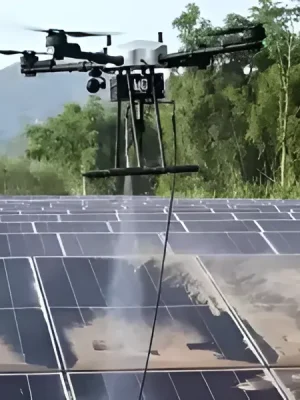
- Remove bonded dirt layers from exterior surfaces
- Cover large vertical areas efficiently
- Maintain consistent standoff distance for safer, uniform cleaning
- Deliver deep clean performance beyond basic sprayer drones
What It Removes Best
Highly effective for:
- Thick pollution film and stuck-on grime
- Cement dust haze after construction activity
- Algae and organic growth on walls
- Heavy industrial dust layers.
Needs surface-specific planning for:
- Sensitive coatings, sealants, older joints, delicate cladding
Why Building & Facility Teams Choose High-Pressure Drones
We provide drone building cleaning and drone facade cleaning for a wide range of properties where safety, speed, and consistent finish matter.
Deep-clean results in less time
Breaks stubborn buildup faster than standard spray methods.
Reduced access complexity
Smaller footprint than scaffold-based projects; less disruption near entrances/driveways.
Controlled pressure = safer cleaning
Not “blast everything”—settings are matched to material to reduce risk.
Repeatable coverage
Planned routes and controlled passes reduce missed patches and uneven cleaning.
Clear documentation
Service proof, coverage notes, and visual documentation where applicable.
High-Pressure Drones vs Traditional Pressure Washing
| Factor | High-Pressure Drone Cleaning | Traditional Manual Pressure Washing |
|---|---|---|
| Access | Ground-controlled, less height work | Height work often required |
| Setup | Smaller footprint | Often needs lifts/scaffolds |
| Coverage | Planned, repeatable passes | Depends on crew access |
| Disruption | Lower | Higher (equipment + blocked areas) |
| Safety | Reduced work-at-height exposure | Higher working-at-height risk |
How It Works (High-Pressure Drone Cleaning)
One-Time Deep Clean Projects
Ideal for seasonal restoration, post-construction cleanup, and heavy grime removal.
Best when surfaces need a visible reset to restore performance and appearance.
Scheduled High-Pressure Cycles
Quarterly or bi-annual deep cleaning for sites that repeatedly build stubborn layers.
Recommended for locations affected by dust, pollution, humidity, or industrial fallout.
High-Pressure Cleaning + Inspection (Optional)
Add visual documentation to record defects, staining patterns, cracks, and damage indicators.
Helps plan maintenance follow-up and track surface condition over time.
Industries We Serve (Window / Glass Cleaning Drones)
Site Assessment & Surface Check: We evaluate the material type, dirt severity, access points, and site safety rules to confirm feasibility and the right approach.
Pressure Planning: We choose the nozzle pattern, pressure range, and standoff distance to match the surface and reduce risk to coatings/joints.
Autonomous Flight Plan: An obstacle-aware route is planned for consistent, full-area coverage with controlled passes.
High-Pressure Cleaning Mission: The drone performs deep-clean passes with monitored pressure and uniform coverage to remove bonded grime/algae/cement dust film.
Report Delivery: You receive service proof and a clear findings summary for facility tracking and maintenance planning.
Industries We Serve (High-Pressure Drone Cleaning)
Industrial & Manufacturing: Factories, plants, and process dust zones where heavy residue and soot buildup is common.
Commercial & Public Buildings: Campuses, large exterior walls, and parking structures that need deep cleaning with minimal disruption.
Construction & Infrastructure: Post-construction cleanup for bonded cement dust film and surface restoration.
Hospitality & Retail (Site Dependent): Service elevations, back-of-house walls, and select facades where access is difficult and appearance matters.
Services We Offer
One-Time Deep Clean Projects
Ideal for seasonal restoration, post-construction cleanup, and heavy grime removal—best when surfaces need a visible reset.
Scheduled High-Pressure Cycles
Quarterly/bi-annual deep cleaning for sites that repeatedly build stubborn layers due to dust, pollution, humidity, or industrial fallout.
High-Pressure Cleaning + Inspection (Optional)
Add visual documentation to record defects, staining patterns, cracks, and damage indicators for maintenance follow-up.
Why Choose Sky Sweeper Drones (High-Pressure Cleaning)
Surface-specific protocols
Pressure, nozzle pattern, and distance are matched to the material to reduce risk to coatings, joints, and finishes.
Lower disruption
Smaller setup footprint compared to scaffold-heavy work, with easier access management around public zones.
Controlled operation + planned routes
Repeatable passes deliver a more uniform finish with fewer missed patches.
Clear reporting
Service proof and findings notes that support facility tracking and compliance documentation.
Scalable execution
Suitable for large elevations, long boundary walls, parking structures, and multi-building campuses.
FAQs -High-Pressure Water Cleaning Drones
1) What can high-pressure water cleaning drones clean?
They remove heavy grime, cement dust film, algae, and stubborn buildup from concrete and many exterior surfaces.
2) Is high-pressure drone cleaning safe for cladding and glass?
It can be—only when pressure and distance are reduced and matched to the surface. We assess material and apply safe settings.
3) Do high-pressure drones replace scaffolding completely?
For many deep cleaning tasks, they can reduce or avoid scaffolding. For repairs or sensitive restoration, traditional access may still be needed.
4) Can high-pressure drones clean algae and mildew?
Yes. They are effective on organic growth, especially on concrete and shaded walls, subject to surface condition and site rules.
5) Do you use chemicals with high-pressure cleaning?
Only if required and only with site-approved solutions. Many jobs can be done using water pressure alone.